
After last week’s fantastically tough marathon race at H9 – Dragon’s Spine, I wasn’t sure how quickly I was going to recover from the epic ascents and descents of the H9, so I didn’t sign up for the 5k the following Saturday (I’d already registered for the XTERRA Auburn Trail 20k, so I couldn’t take that back). However, although Sunday’s shakeout run following the race was a bit of a slog, I wasn’t prohibitively sore and had full range of motion. By Tuesday, I had resumed my training plan, and I even got in a great speed session on Thursday with only had some lingering quad soreness and no hamstring pain.
So. There was no excuse not to run the I Run Opelika 5k (except that 5ks are miserable terrible things), but it still took me until Friday afternoon to enter my credit card information on the registration site. If I had it my way, I’d never have to register for any race until the night before. I like to make sure I’m really really ready to go. Anyway, register I did, and then I immediately started dreading it. 5k’s are hard.
I Run Opelika 5k
Race morning, the heavy rain wasn’t forecasted to start until 9 am, so I headed to the start to pick up my packet and run a two mile warm-up. The warm-up gave me a preview of what the course would look like, and it was immediately clear that the race directors hadn’t tried to avoid any of the hills in the area – this wasn’t going to be fast. I completed my warm up and headed to the start to rehydrate and wait for the gun. It was already hot and humid, although nowhere near normal Alabama heat and humidity. Turnout was really good for what I’d initially thought was going to be a small, local race. As I looked around, it looked like there a lot of fast people there, including a local high school’s cross-country team. And yet, I found myself at the front of the pack at the start. I kept trying to move behind people as we waited to start, sure that I didn’t belong at the front of the pack, but those runners kept moving back too. Resigned, I waited for the start at the start. Right on time, we started. Although I expected to be trampled by a pack of faster runners, just a few men runners shot off, and I was at the front of the pack. The first mile of a 5k is always fun. I was nice and warmed up, and my speed felt good. I was pushing hard, so I knew this exhilaration couldn’t last, but I decided to enjoy it whilst it lasted.
And, right on cue, it started to hurt toward the end of mike one. The hills had begun toward the middle of mile 1, and mile two was up and down. My legs started to burn, and I started to feel like I was going to throw up. Not a bad sign – this is how I know I pushing at my absolute limit in a 5k. Still, I knew that I couldn’t maintain my pace without throwing up, so I eased up a bit to recover on the descents. The course was an out and back, so I could see on the way back after the halfway mark how close the other women were. At the turnaround, I was still leading the women’s race: one woman who looked strong was a few seconds behind me; the third pace woman was about a minute back. I kept pushing, but I was slowing down as I allowed myself a little recovery, and I was passed by the second place woman around mile two. I was at my max speed, so I helplessly watched her pass, but I maintained as we pushed through the last mile. After three blocks from the finish there was a super steep climb that almost broke me, but it was short. I pushed to the finish. I finished as second place woman overall, first in my AG, for my slowest 5k since my first 5k ten years ago. But I was happy with my performance – I went out and gave it my absolute best. I can’t control the course, and I can’t control who shows up, but I can control how I respond to course conditions, competition, and context. I gave it my best, and I was happy with it.
Post-5k, I took recovery seriously and after a refreshing mile swim (and jogged cool-down miles), I made it my goal to stay off my feet the rest of the day. Sunday morning dawned cool and early. I arrived at the race around thirty minutes before the start. As I drove up the tiny hill that led to the race start, I started to see indications of the type of trail I’d be running.
XTERRA Trail Run 20k
In contrast to last week’s trail marathon, this course was not my strength – the Chewacla trail is single-track, mostly flat, and covered in roots and rocks and other trippable things. I felt my heart sink, and my dream of another competitive performance started to diminish. Further, I saw the competition would be steep in the 20k distance as well, with some strong local (and non-local) runners. Despite being the second year of the XTERRA trail run, turnout was good. I didn’t know how I’d do, but I resolved to stick to my race place: start at a steady pace and maintain it until the last three miles, in which case I’d push if I was feeling up to it and the circumstances demanded it.
In contrast to the race information, the race started with the 5k’ers, followed by the 10k runners, and then the 20k racers. As I watched the 5k and 10k races start, it dawned on my that even if I started at the front of the pack, I’d still have to pass many slower 5k and 10k runners on the single-track trail, which would further complicate navigation of the technical trail. Resigned to a less than ideal course, we made our way to the start and, as raindrops started to fall, we set off. A few runners started off fast, and I fell towards the back of the front of the pack. As I feared, the trail became technical immediately, yet flat and even gently sloping downhill in places. As long as I kept my eyes on the trail, I was able to navigate without losing speed. As anticipated, I had to start passing runners almost immediately. Passing was complicated when runners didn’t step aside to let me pass, even when I asked, so I had to navigate past them without falling or running into them. Normally, I would be excited to pass people because it might be improving my race placement, but because the 5k and 10k races started before us, I didn’t know if I was passing a 20k runner as I moved through the pack. That isn’t a problem, except that it was already taking all of my focus not to trip, and navigating people and the wilderness or rocks to the side of trail wasn’t helping my smooth forward progress.
After four miles or so, I’d passed the bulk of runners, so I could focus on maintaining a solid pace and pushing through the 10k and 15k points and the real race could begin. This course was two 10k loops, and I made it through the first loop feeling good, but definitely starting to feel the fatigue in my legs, accumulated from a trail marathon and 5k. I knew that as my legs fatigued, it would be easier to trip because I wasn’t lifting my feet as high, so I refocused on my legs and ate half of a power bar to fuel. The bright side of the second loop, aside from being closer to the finish, was that I knew that anyone I passed would be a 20k runner, so redoubled my efforts, energized by the power bar. The first part of the second loop is fast, although trippy, and I pushed hard, searching for runners to pass. I had my first and only fall, stumbling on a run as I navigated a particularly technical section. No serious damage, except that I was a bit shaken, but after a few steps, I picked up my pace again, and saw a woman runner pass by on a switchback. My heart quickened – I like passing men, of course, but if I want a podium finish, I have to pass women, so while I didn’t know how far ahead this runner was, because I wasn’t familiar with the course, I felt energized at the chance to chase down a woman runner.
Now, I hadn’t been paying attention at the start of the run at who was ahead of me, and any sense I did have was lost in the mix of passing 5k and 10k runners, but I suspected that there were only a few women runners ahead of me. Even if it didn’t mean a podium finish, passing a woman would improve my finish ranking, so I started pushing hard. The power bar had kicked in and the course had started to have more dramatic ascents, so I powered on. Finally, with around three miles left, I saw the woman runner on the trail ahead of me, and I ramped up my speed. She saw me coming at the aid station and rushed through the station, dropping her cup and setting off on a sprint. I had my hydration pack, so I didn’t need to stop, and I started my chase.
We came to a road, and she was just feet ahead of me, and moved on the road by a volunteer to block my path around her. I knew what she was doing and knew how bad of a position she was in – being chased is a terrible feeling and I had the advantage. With less than three miles left, I didn’t want to run out of course, but I knew I was feeling good, so I settled back and let her run. This frantic pace continued for a mile, and I let her sprint as we passed runner after runner through the course. We were flying through the course, but as the course started to ascend, I could see her pace start to flag. In contrast, I was feeling great. It was hard, for sure, but I was feeling strong and pushing through the pain, helped I’m sure, by adrenaline. I have no doubt I had a huge grin on my face as I stayed consistently behind her, waiting for her pace to slow so I could pass.
At the same time, I half hoped that this pursuit would continue until the finish. This was the very essence of competition, when another runner pushes you to go beyond what you thought you were capable of. On a particularly steep descent she slowed considerably, and I took my chance to pass, and stepped by, on the ridge of the trail, to push by. I kept pushing hard as our positions were now reversed, and I was determined to build a big gap that would allow me a cushion if slowed in the steep ascents towards the finish of the course. Within a quarter of a mile, she was out of sight. I settled back into a more sustainable pace that I’d keep until the finish of the race. After passing a few more men runners, I sprinted to the finish. It wasn’t until I stepped over the recreation area that I saw that only two women had finished ahead of me, and I had a podium finish as third place woman overall.
Now, and I mean this, the consistent pace and fast, smart strategy that I ran with would have made me feel amazing regardless of my finish. The podium finish was just icing on the cake. After two good weekends of racing, I’m feeling good about my capabilities as a runner – albeit a bit unsure of why I haven’t been able to push like this until the last couple years of running, when I’ve started to place well. Even though I won a few races prior to this season, however, I’ve never been able to race like I’m running this year. Somehow, after years of running, I finally figured out how to go out hard and keep pushing, even when it gets hard and starts to hurt.
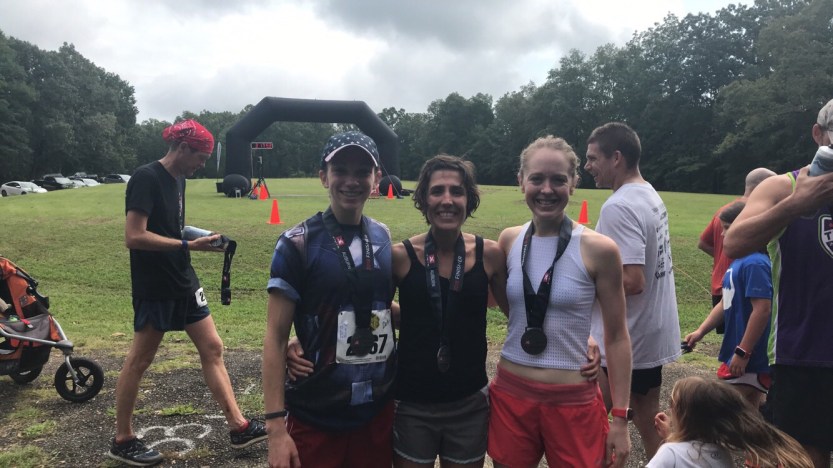
This year marks my sixth year of running, so I think despite the fact that I’m getting older and my fitness should be declining, because I started running so late in life I’m still mastering the skill (and, maybe, just now accumulated my 10,000 hours of running). Nutrition-wise, I’ve finally figured out how to fuel my runs and my life – I have a good idea of how much I need to eat and what I can eat without making me sick while still meeting my nutritional needs. I’m eating more than I have in a decade – but I’m eating enough, which is shockingly important for running. I also think that after years of running, I’ve learned that I can hurt real bad and still survive. Without the stress of grad school, I have more emotional and mental resources to dedicate to racing hard. Finally, despite being an Alabama summer, the weather gods have been very kind to me this year, at least as far as race weather goes. Gentle rain and moderate temps and humidity levels (maxing in the 80’s) makes running hard easier.
Whatever it is, I like it. Now it’s time for me to balance training and recovery, so I can keep doing this running thing for a lifetime.
That is, after the 50k this weekend.
Just kidding. Maybe.
 ultrarungal