Since moving to North Dakota in fall 2020, I’d wanted to do two things: 2) Run the entire Mah Daah Hey Trail (and set a FKT), and 2) establish and set the FKT for crossing the Sheyenne National Grasslands. But, whether due to COVID or to other factors (or both), I didn’t race or do any competitive running for two and a half years. Yet, now I was in shape and needing to get in some serious mileage for my next 100-mile race. I needed some time to recover from Lake Wobegon, and, I needed some help to figure out how to submit a route to the Fastest Known Time website for a trail I’d never run. The folks at FKT now require a route to be submitted in advance of a FKT attempt, so I spent a few months trying to track down the GPX file for the portion of the North Country Trail that ran through the grasslands.
Eventually, I learned how to edit GPX files and submitted what I thought was the appropriate GPX track – that route was approved and, upon approval, I started planning for a FKT attempt that Saturday (I believe I found out it was approved on Wednesday or Thursday that week). Luckily my running partner was supportive and excited, and he agreed to go with me to trail on Friday to get some beta and cache some water. This, however, was where I learned that the GPX file I’d submitted for the route on the FKT website was incorrect – the North Country Trail does go to outer border of the grasslands, but the trailhead to trailhead distance was only 28 miles (the route I’d submitted was 30 miles). A ranger at the trail said that the point I’d marked as the outer edge of the trail was very difficult to get to and, perhaps, impossible to get to in my car. It logically made sense (to me?) that a crossing would be trailhead to trailhead, so I settled on starting at the east trailhead Saturday morning and running West to the West trailhead (and I hoped it wouldn’t cause too much confusion when I submitted my FKT attempt – so I emailed the regional FKT director as soon as I got home to provide an update on the loop).
It was perfect FKT weather – in the mid-50’s and overcast. Still, I wanted to start as early as possible before the skies cleared and the sun came out. That meant a 6 am start, so we left our house around 5 am to get to the East trailhead. M ran the first four miles with me (making it a supported FKT attempt). The first four miles were the toughest part of the entire attempt; I still hadn’t figured out how to fuel attempts when I couldn’t eat breakfast right before I ran, so I struggled with low blood sugar for the first four miles of the attempt. Luckily, the faint-y feeling passed, but those were my slowest miles of the entire attempt until the end, when I was literally blocked from the trail by a herd of angry cows.
But, around mile five, a mile after M headed back to the car to head home, shower, then head back to meet me at the West Trailhead, I started to feel really good. Until past the mid-way point, the trail is mostly shaded and running through the gently rolling hills (albeit sandy in places) in and out of copses of trees is absolutely beautiful. Although the wind was picking up, the trees protected me from the worst of it, and I hit the first cache around mile 13 (this was the soonest we could cache supplies because the “roads” to the early points of the trail were not accessible via my vehicle). This was fine, though, I actually never came even close to running out of food or water, and, I think, I could have done the entire attempt with my hydration pack because it never got too hot and I started super-hydrated.
Overall, the hardest part of the trail, technically, was the sandiness, which made ascents, descents, and flats slow because the terrain was so unstable. Once I left the tree-covered portions of the early miles, the wind picked up, and the times heading into a 12-17 mph headwind were tough. The portion through the part of the trail one might think of as the traditional grasslands was remote and beautiful but completely exposed. There were places with some tree coverage including a completely magical portion almost at the end of the trail, where suddenly I was walking through what looked and felt like woods in Northern Idaho, complete with fir trees, but it felt very exposed.
It was the exposed part of the trail that made what happened at the end, about a mile from the West trailhead, so scary. Throughout much of the grasslands, we share the trail with grazing cattle. This is not unusual, I ran into cow pies in the Collegiate Trail, for example, but these cows were often right up on the trail and, with baby calves in tow, were fiercely protective. Early on, I came across a cow and calves, but they were off of the trail about 100 yards, so I stuck to the trail and slowly moved past them. The cow mooed angrily, but while I was relieved to be past them, I didn’t feel afraid. Later, however, after the trail opened up to the grasslands, the number of cows by the trail increased, so instead of one or two plus calves, it was larger herds. After the second and final water cache, around mile 22, I ran into a herd that was about 50 feet from the trail. Again, I slowed and tried to seem non-threatening, but the entire herd started to move, and I heard what sounded like angry moo’s for a mile or two as I ran away.
But this was nothing when, about a mile from the trail, I lifted the gate and walked to see the entire trail blocked by a herd of cows. It looked like their feed had been set up just a few feet from the trail, and directly in front of me were two baby calves. In total, there were 40-50 cows, and they were tightly packed, meaning that I couldn’t navigate through them without getting very close. As I moved, slowly, the adult cows on the outer edges started to move toward me. Remembering the trail instructions to give the cows a wide berth, I stepped off the trail and walked through the grassland, as quickly as I could without drawing attention. I suppose I was never closer than 50 feet from the nearest cows, but as I walked past, two started to move toward me, scaring me to pieces. The terrain was full of big tufted grass, so I couldn’t have run quickly or far without falling, so I moved even further away and kept heading in the general direction of where the trail picked up after the herd. This took what felt like forever but was probably only 20 minutes. It never felt safe, and I am still frustrated that feed was placed so close to a trail that made it unsafe for humans. Luckily, though, I made it past without any harm, and once I arrived, started heading to the West trailhead.
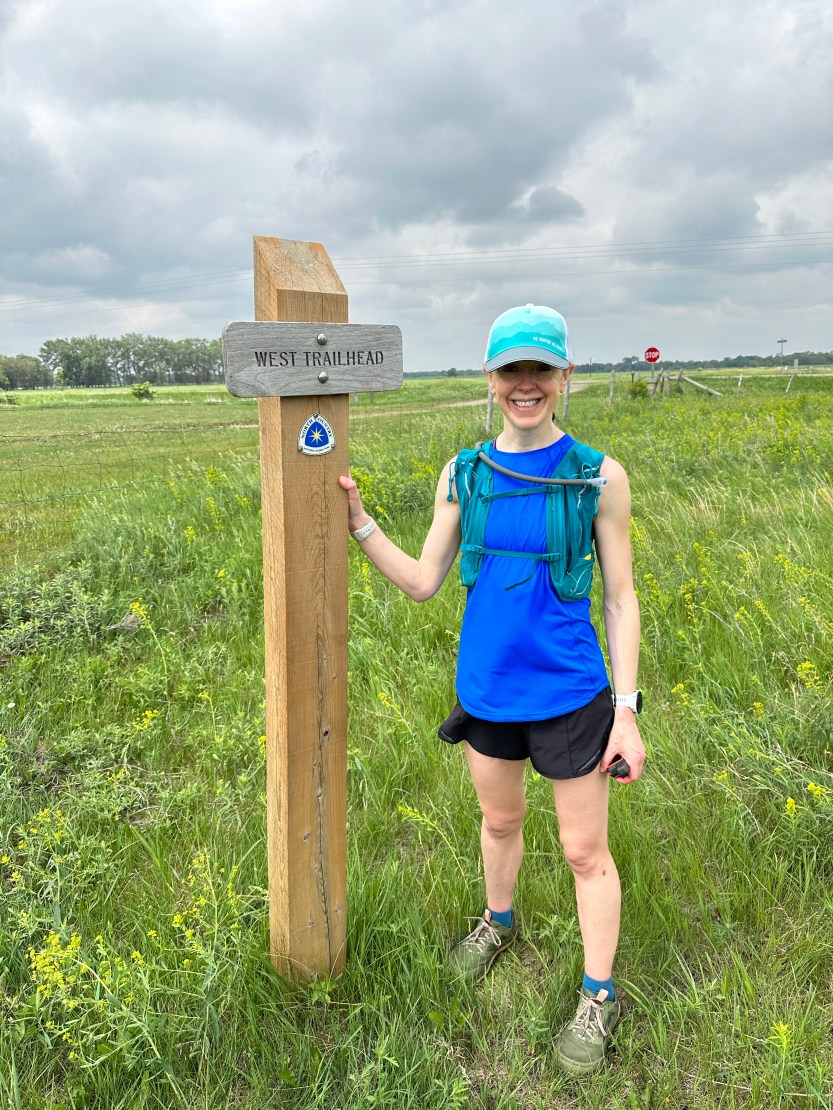
Without any further incident, I made it to the West trailhead for a total crossing time of 5:39:03.
 ultrarungal